
The medical supplies distribution business in India is booming. With 70,000+ hospitals, 200,000+ clinics, 500,000+ beauty salons, and millions of small healthcare providers, the demand for consistent, quality supply of products like nitrile gloves, syringes, surgical instruments, and safety equipment is massive.
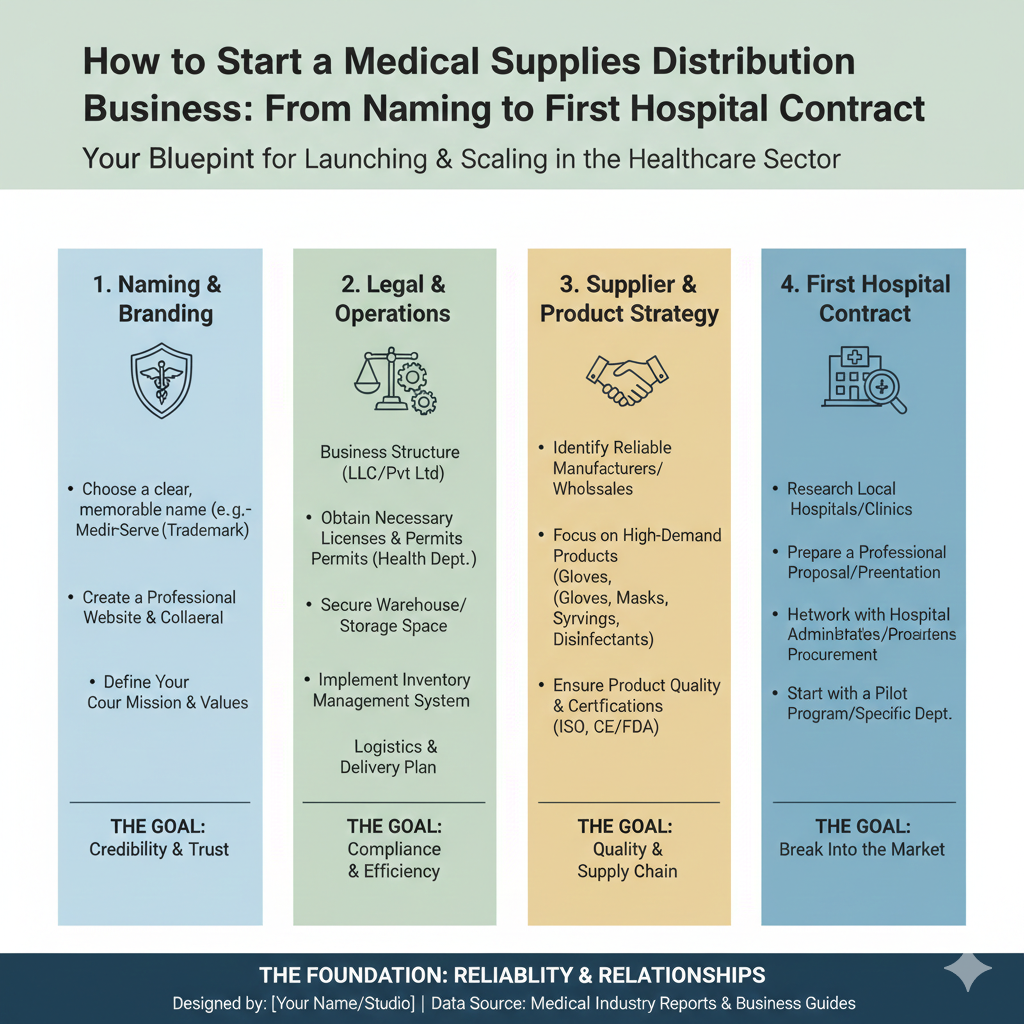
But here’s what separates distributors making ₹15-30 lakhs annually from those struggling at ₹3-5 lakhs: they treat distribution like a professional business from day one, not a side hustle with vague plans.
I’ve watched dozens of people make the leap from salaried jobs into medical supplies distribution. The successful ones followed a systematic launch process. The failures? They bought ₹50,000 worth of random products, made a WhatsApp group called “Medical Supplies,” and wondered why hospitals didn’t take them seriously.
Let me walk you through the exact process that works, starting months before you even order your first inventory.
The Business Name Problem Nobody Solves Properly
You’ve decided to distribute medical supplies. Maybe it’s nitrile gloves for beauty salons. Maybe it’s surgical instruments to clinics. Maybe it’s safety equipment for dental offices. Your target market is clear. You’re ready to start.
Your first instinct is probably to call it something generic: “Sharma Medical Supplies,” “Krishna Healthcare Distribution,” or “MediCare Solutions.”
Stop right there.
The medical supplies space in India is saturated with 50,000+ distributors using variations of the same five words: Medical, Health, Care, Supplies, Solutions. Your name disappears into the noise before a hospital procurement officer even considers your proposal.
I know a former pharma sales rep who launched “Premium Medical Solutions” as his distribution business. Sounded professional to him. But when hospital procurement teams Googled the name to verify legitimacy, they found 200+ businesses with similar names across India. Zero differentiation. His business was invisible.
He spent nine months struggling to establish credibility, finally rebranded to “SterileGuard India” (focusing specifically on infection control products), and immediately his conversion improved. The new name was memorable, searchable, and clearly communicated specialization. Hospitals could find him, remember him, and trust that he was focused on their specific needs.
Before you commit to any business name, check how many similar names already exist in medical distribution. You don’t want to launch “Healthcare Enterprises” only to discover there are 500 variations already competing for attention in hospital procurement systems and Google searches.
For your distribution business name, consider focusing on your specific niche rather than generic terms. “GloveSource India” (if distributing gloves) is far more memorable than “Medical Products Distribution.” Think about what makes you different and build that into your identity from day one.
AI-powered naming tools can generate dozens of creative options based on your specific distribution niche, helping you find names that are both professional and distinctive.
The Foundation: Target Market Before Inventory
Here’s a mistake I see constantly: new distributors buy ₹1 lakh worth of mixed inventory (gloves, syringes, masks, instruments), then try to figure out who to sell to. Six months of slow sales, inventory sitting in storage, cash flow problems.
Smart distributors flip this. They identify a specific target market first, understand exact needs through conversations with 10-20 potential buyers, THEN source products based on confirmed demand.
The beauty of medical distribution is you can start with almost zero inventory if you build supplier relationships correctly. Many manufacturers are willing to drop-ship for verified distributors, especially when you’re starting out.
But you need to prove you’re a real business, not someone sending inquiry forms with temporary email addresses hoping to get free pricing information. This is where professional infrastructure matters from day one.
Your Digital Foundation: Website That Builds Trust
Medical procurement—whether for hospitals, clinics, or salons—is a trust business. Before someone gives you a ₹50,000 order, they Google your business name. What they find determines whether they trust you or move on to the next distributor.
I’ve seen exceptional distribution businesses lose hospital contracts because their online presence was amateur:
- No website, just a Facebook page
- Website with broken links and outdated product listings
- Contact forms that don’t work
- No clear business registration or certification information
- Inconsistent branding across different platforms
But here’s what most new distributors don’t realize: your website affects both trust AND discoverability. When a new dental clinic opens in your city and searches “nitrile gloves supplier [city name],” you want to appear in those search results. This requires proper technical setup.
Your site needs a clear structure that search engines can understand—a sitemap that tells Google “here are my product categories, here’s my contact page, here’s my certification page, here’s my pricing request form.” Without this, Google might index your homepage but miss your main product pages.
Setting this up early matters because your first 20-30 customers will likely find you through local Google searches. “Medical supplies distributor in Pune” or “nitrile gloves bulk supplier Mumbai” or “surgical instruments dealer Bangalore”—these searches represent people actively looking to buy. But only if search engines know your content exists and can categorize it properly.
Tools exist specifically for generating these technical sitemaps, ensuring your business appears in relevant searches when new clinics, salons, or hospitals are looking for suppliers.
The Pre-Launch Validation Process
Here’s how smart distributors validate their business before investing heavily:
Month 1: Pick your niche (specific products to specific customers), validate business name uniqueness, register business entity (proprietorship minimum), set up basic website with proper structure, create professional email (@yourbusinessname.com, not @gmail.com).
Month 2: Research 50 potential customers in your target segment. Visit 20 personally. Understand their current suppliers, pain points, order quantities, payment terms, delivery expectations. Collect specific product requirements.
Month 3: Identify 3-5 manufacturers whose products match customer needs. Establish distributor relationships. Negotiate terms. Get sample products for quality verification. Present samples to the 20 customers you visited—collect feedback.
Month 4: Secure your first 5 committed customers with written orders or POs. Use these confirmed orders to negotiate better terms with manufacturers. Fulfill first orders flawlessly, over-delivering on promises.
Month 5-6: Build testimonials from first 5 customers. Use social proof to approach the next 20 customers. Refine processes based on early learnings. Establish reliability reputation.
Month 7+: Scale systematically. Add more manufacturers to product range. Expand to adjacent customer segments. Build referral systems.
This timeline compresses months of uncertainty into systematic validation. Each step builds on the previous, and each requires investment only if the previous succeeded.
Compare this to the common approach: buy ₹1 lakh inventory, blast WhatsApp groups with pricing, hope someone orders, struggle with cash flow when inventory doesn’t move, give up after 6 months. Thousands of hours wasted because validation happened too late.
The Operational Infrastructure That Matters
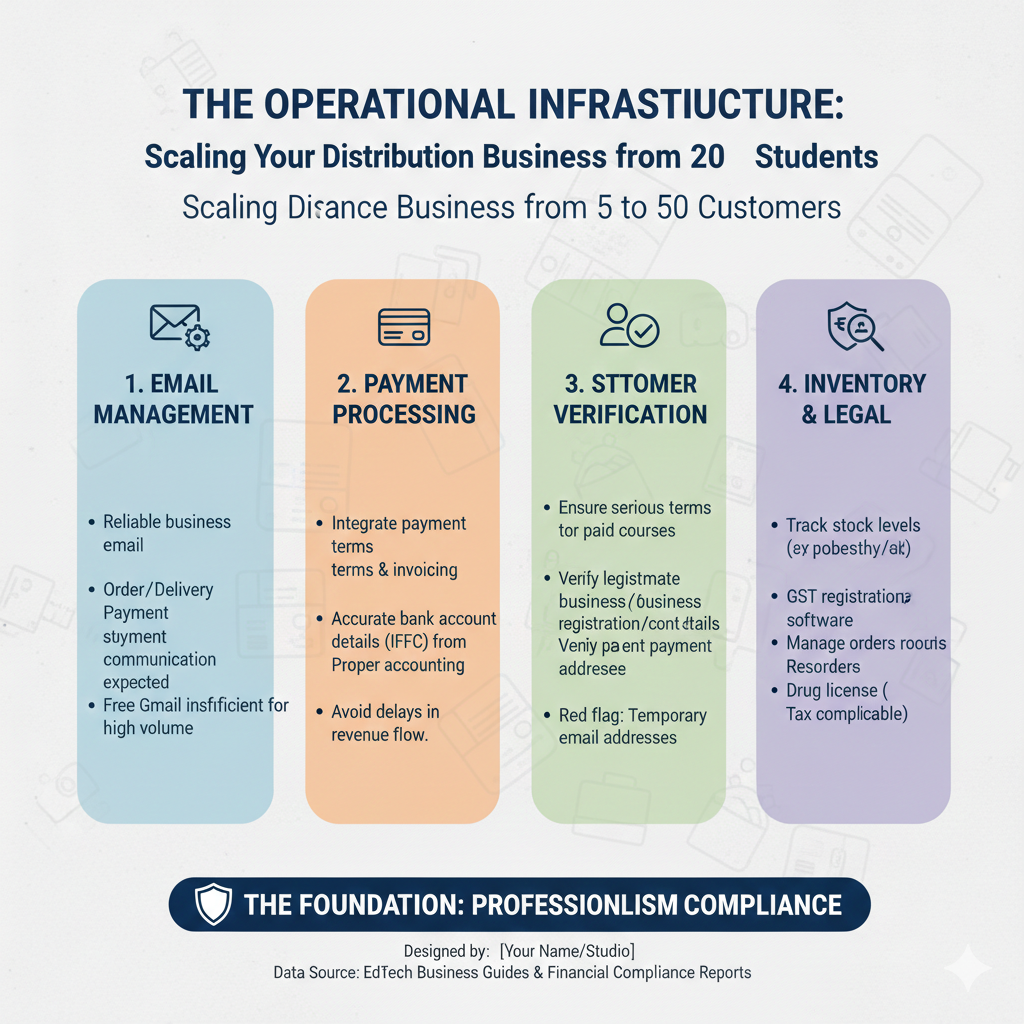
As your distribution business grows from 5 customers to 50, operational basics become critical:
Email Management: You need a reliable business email for order confirmations, delivery notifications, payment receipts, and customer support. Free Gmail doesn’t cut it when you’re handling ₹5 lakh monthly order volumes. Customers expect professional communication.
Payment Processing: Clear payment terms, organized invoicing, proper accounting. This requires accurate bank account details configured correctly across all systems. One wrong IFSC code in your payment gateway means delayed settlement of ₹2 lakh in receivables.
Customer Verification: When a new clinic submits an inquiry for ₹30,000 worth of products, you want to verify they’re legitimate. Real business registration, valid contact details, payment capacity verification. This prevents fraud and ensures you’re not shipping ₹30K of inventory to a fake business that vanishes.
Some verification is simple: does their email address come from an actual business domain or at least a permanent personal email? Temporary email addresses that self-destruct after 24 hours are red flags—serious buyers use real contact information.
Inventory Management: As you grow, you need systems to track what’s in stock, what’s ordered from manufacturers, what’s committed to customers, what needs reordering. Spreadsheets work until 20 customers; beyond that you need proper inventory software.
Legal Compliance: Business registration, GST enrollment, drug license (if distributing regulated medical products), proper invoicing, tax compliance. These aren’t optional once you cross ₹20 lakhs revenue. Getting this right from day one prevents expensive fixes later.
Positioning Against Established Distributors
The medical supplies distribution market has established players—multi-city distributors with decades of hospital relationships. How does a new distributor compete?
Specialization and service quality.
Established distributors serve everyone, which means they serve no one particularly well. You specialize in specific products for specific customers. “Nitrile gloves specialist for beauty salons and spas” beats “general medical supplies distributor” when the right salon owner is looking.
You offer same-day delivery in your city (established distributors take 3-5 days). You price competitively because you don’t have legacy overhead. You respond to WhatsApp inquiries in 2 hours instead of “submit inquiry form, we’ll call you in 3 days.”
Your positioning should emphasize these advantages rather than trying to match the scale of established players. You’re not competing with the distributor serving 500 hospitals. You’re an accessible specialist for salons, clinics, and small practices who want personalized service.
Building Your Customer Base Systematically
Once your business fundamentals are solid—good name, professional website, verified supplier relationships, proper systems—customer acquisition becomes systematic:
Local Targeting: Start with one city or region. Become THE distributor for nitrile gloves to beauty salons in your area before trying to serve hospitals in five states. Deep local penetration beats thin national coverage.
Direct Outreach: Visit customers personally. A 15-minute meeting with a salon owner where you demonstrate product quality and explain delivery terms converts 10x better than cold emails. Face-to-face matters in distribution.
Referral Systems: Your first 10 satisfied customers are your best salespeople. Offer them ₹500 credit for every referral that places an order. Salons know other salons. Dentists know other dentists. Make it easy for them to refer you.
Solving Specific Pain Points: Established distributors make customers wait 5 days for delivery and require ₹10,000 minimum orders. You offer next-day delivery and ₹3,000 minimums. These specific service improvements attract customers who are underserved by large distributors.
Content Marketing: Blog about “How to Choose Quality Nitrile Gloves for Salon Use” or “Why Beauty Salons Should Use Powder-Free Gloves.” This builds authority, drives organic traffic, and educates your target market while positioning you as the expert.
The First Year Reality Check
Let’s be honest about realistic expectations:
Months 1-3: Building foundation. Revenue: ₹0 (investment phase)
Months 4-6: First customers. Revenue: ₹50,000-1.5 lakhs (5-10 small customers)
Months 7-9: Growing base. Revenue: ₹2-4 lakhs/month (20-30 regular customers)
Months 10-12: Establishing presence. Revenue: ₹5-8 lakhs/month (40-50 customers + repeat orders)
By end of year one, successful distributors are at ₹50-80 lakhs annual revenue with 50+ regular customers. This won’t replace a high-paying corporate job immediately, but it’s real business traction with clear growth trajectory.
Year two is where many hit ₹1-1.5 crores by expanding product range, adding adjacent customer segments (from salons to clinics, for example), and benefiting from established reputation and referrals.
Why Most Distribution Businesses Fail
They skip the boring parts:
- Pick a generic name without differentiation
- Buy inventory before confirming demand
- Launch with amateur digital presence
- Ignore systematic customer acquisition
- Don’t build proper business infrastructure
- Give up after first slow quarter
The successful ones treat distribution like the business it is. They do the unglamorous work of naming, verification, systems, and targeted customer development before scaling.
Your product knowledge is necessary but not sufficient. You also need business fundamentals: distinctive brand identity, professional web presence, systematic supplier relationships, verified customer base, and operational excellence.
The Unsexy Truth About Distribution Success
Distribution isn’t glamorous. It’s logistics, inventory management, payment collection, delivery coordination, and customer service. But it’s also one of the few businesses you can start with ₹50,000-1 lakh investment and scale to ₹2-5 crore revenue within 3-5 years if you execute correctly.
The Indian medical supplies market will continue growing—healthcare expansion, increasing hygiene awareness, salon industry boom, dental clinic proliferation. The question is whether you’ll be one of the distributors building real businesses or one of the thousands who tried with a WhatsApp group and quit within six months.
Build professional infrastructure from day one. Distinctive business name, proper website setup, verified supplier relationships, systematic customer acquisition, quality over quantity in every decision.
Your future customers—and your future revenue—depend on the foundation you build in these first few months.
Don’t rush it. Don’t cut corners. Build it right.
Because distribution is a relationship business built on trust, and trust requires professionalism at every touchpoint—from your business name to your email address to your delivery reliability.
Get the foundation right. The ₹1 crore revenue will follow.
Conclusion
If there’s one thing I’ve learned watching dozens of distributors succeed—and just as many quietly disappear—it’s this: medical supplies distribution isn’t won by hustle, it’s won by discipline.
The winners don’t look flashy in the beginning. They’re not the ones blasting price lists on WhatsApp or stocking random cartons in their living room. They’re the ones doing the slow, boring, almost invisible work. Picking a name that sounds trustworthy. Setting up a proper website before the first sale. Visiting clinics one by one. Talking to salon owners. Testing samples. Fixing small operational gaps. Sending professional invoices. Delivering on time. Every single time.
None of it feels exciting. But every small action builds something far more valuable than quick revenue—it builds trust.
And trust is the real currency in this business.
When a hospital places a ₹2 lakh order, they aren’t just buying gloves or syringes. They’re betting that you won’t disappear tomorrow. They’re betting their patients’ safety on your reliability. That kind of confidence only comes from professionalism at every touchpoint—your brand, your communication, your systems, your consistency.
The beautiful part? You don’t need crores to start. You don’t need a warehouse full of inventory. You don’t need connections in every city. You just need to treat this like a real business from day one—focused niche, validated demand, solid suppliers, clean processes, and service that actually cares.
Do that patiently for 12 months and you won’t be chasing customers. Customers will start calling you.
So slow down. Build the foundation properly. Choose clarity over speed. Quality over shortcuts. Relationships over quick margins.
Because in medical supplies distribution, the people who build it right once… rarely have to start again.
And that’s how small distributors quietly grow into ₹1 crore businesses.