
You manufacture quality products—nitrile gloves, beauty supplies, medical equipment, salon products. You’ve set up a professional website with a “Become a Distributor” inquiry form. You get 50 inquiries per month. You’re excited about expanding your distribution network.
Then you start following up.
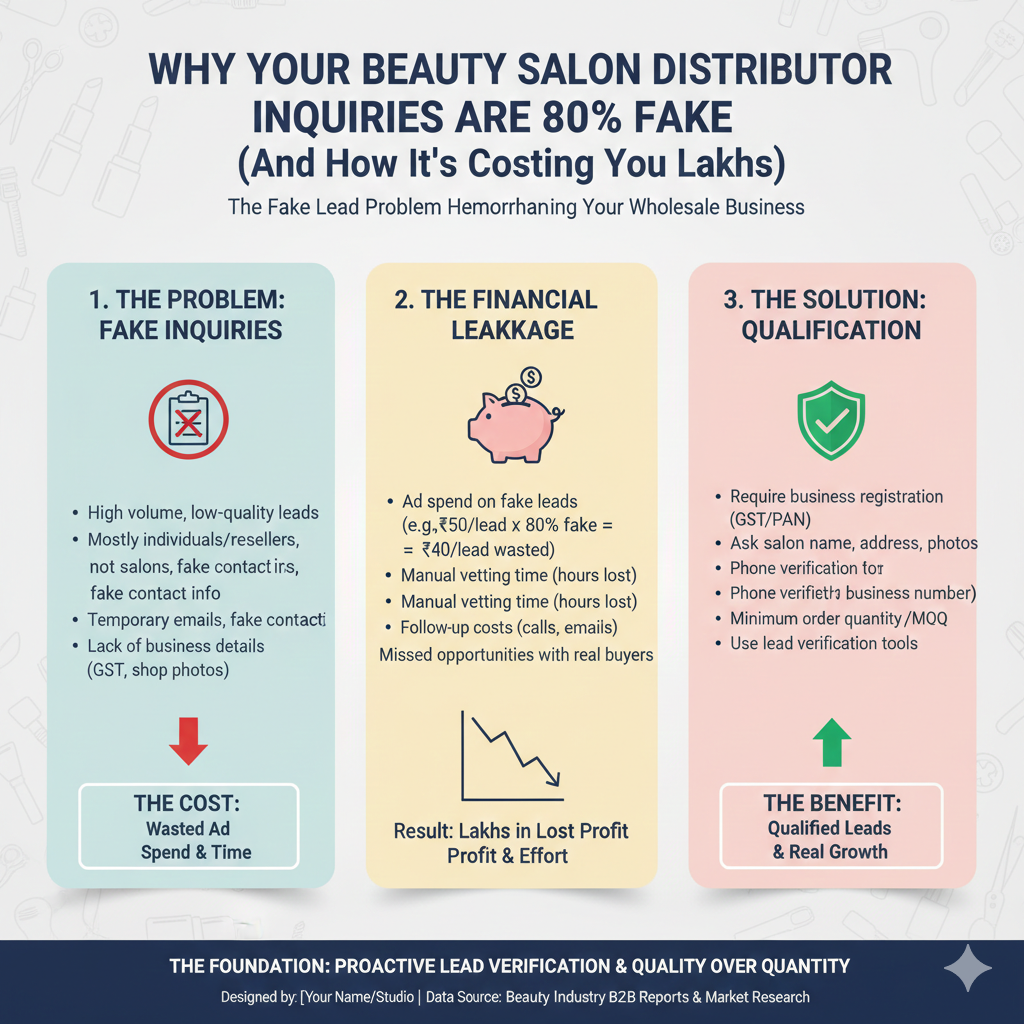
Thirty emails bounce immediately. Fifteen phone numbers are disconnected or wrong. The remaining five? Three never respond to your emails. One responds once, asks for pricing, then disappears. Only one inquiry turns into an actual distributor conversation—and they don’t even place an order.
You just wasted 40 hours of your sales team’s time on leads that were never real. At ₹500/hour in salesperson cost, that’s ₹20,000 monthly down the drain. Annually? ₹2.4 lakhs in pure waste, chasing ghosts.
This is the brutal reality of B2B lead generation in India’s beauty, medical supplies, and industrial products sectors. And most manufacturers don’t even realize they’re being sabotaged by a problem they can’t see: temporary email addresses.
The Fake Inquiry Epidemic in B2B
I’ve consulted with manufacturers across India—nitrile glove producers, cosmetic suppliers, medical equipment companies, and industrial safety gear manufacturers. The pattern is identical:
Someone fills out your “Distributor Inquiry” form:
- Name: Raj Kumar
- Business: SK Enterprises
- Email: rajkumar2847@tempmail.com
- Phone: 9876543210
- Message: “Interested in bulk order. Please send the catalog and pricing.”
Your sales team sees this and thinks: “Perfect! Another serious distributor inquiry.” They spend an hour researching the potential order size, preparing customized pricing, and drafting a professional email with catalog attachments.
The email bounces. The temporary email address was deleted 24 hours after they submitted the form.
Or worse, it doesn’t bounce—it just sits in a temporary inbox that nobody ever checks again. Your sales team sends three follow-up emails over two weeks, wondering why this “interested distributor” isn’t responding. They mark it as “cold lead” and move on, never realizing the person never had any intention of becoming a distributor.
Why Beauty and Medical Supply Businesses Get Destroyed
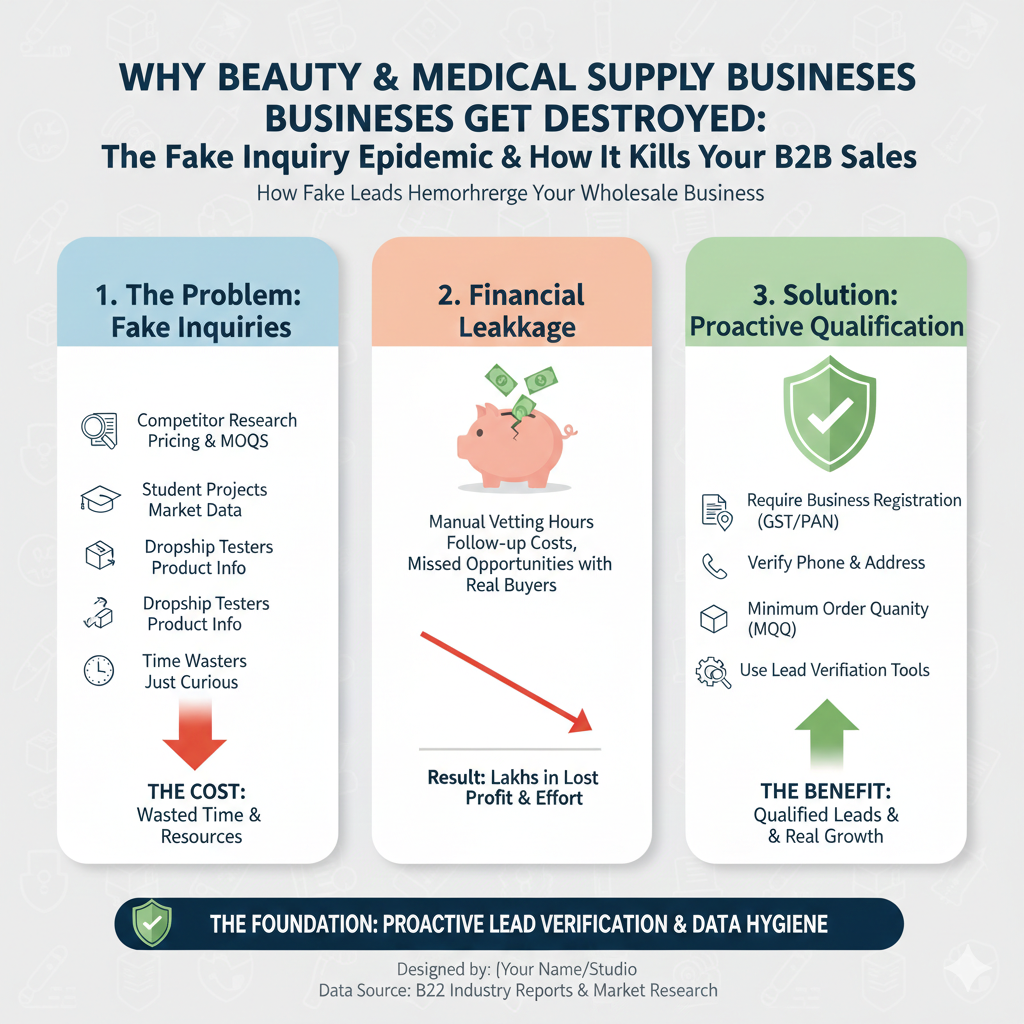
Your industry—whether you’re manufacturing gloves, beauty products, spa equipment, or medical supplies—is particularly vulnerable to fake inquiries for specific reasons:
Competitor Research: Other manufacturers want to know your pricing, your minimum order quantities, and your distribution terms. They submit fake inquiry forms with temporary emails to get your catalog and pricing sheets. They analyze your offers, undercut you, and use your information against you. You think you’re gaining a distributor; they’re gaining competitive intelligence.
Student Projects: Commerce and MBA students doing market research projects on “beauty supply distribution” or “medical equipment pricing in India” fill out dozens of inquiry forms across manufacturers. They need the data for their assignment, not to actually start a business. Temporary emails let them collect information without their professor questioning why they’re using their real college email for business inquiries.
Dropship Testers: People exploring dropshipping businesses want to know if your products are dropship-friendly before committing to anything. They test 20 manufacturers simultaneously using temporary emails because they have no actual business entity yet. Most abandon the idea after getting pricing from 5-10 suppliers.
Time Wasters: Some people are just curious. “How much do nitrile gloves really cost in bulk?” They’ll never buy anything; they’re just browsing. But they fill out your serious B2B inquiry form because it’s the easiest way to get detailed information. A temporary email means they can satisfy curiosity without commitment.
Automation and Bots: Some fake inquiries aren’t even from humans. Automated bots scrape “Contact” and “Distributor Inquiry” forms across the internet, testing for vulnerabilities or collecting business data. They use temporary email addresses because real addresses would get blocked quickly.
The Real Cost of Fake B2B Leads
“So what?” you might think. “Sure, some inquiries are fake, but I’m still getting real distributors too, right?”
Yes. But the fake inquiries are costing you far more than you realize:
Sales Team Waste: Your best salesperson spends 2 hours daily following up on inquiries. If 80% are fake, that’s 1.6 hours daily—32 hours monthly—completely wasted. At ₹30,000 monthly salary, you’re paying ₹19,200 for them to chase ghosts. Scale this across three salespeople, and you’re hemorrhaging ₹57,600 monthly on fake lead follow-up.
Email Infrastructure Damage: When you send emails to temporary addresses that bounce or never engage, email providers like Gmail and Outlook notice. They start categorizing your domain as low-quality. Eventually, even your emails to REAL distributors start landing in spam folders. Your entire business communication channel degrades because fake inquiries polluted your sender reputation.
Pricing Information Leakage: Every fake inquiry you respond to with detailed pricing is competitive intelligence given away for free. If 40 fake inquiries per month are actually competitor research, you’re essentially publishing your pricing strategy to everyone in your industry. This makes it impossible to maintain pricing power or exclusive distribution arrangements.
Opportunity Cost: While your sales team is preparing detailed proposals for fake leads, they’re NOT spending time nurturing the few real distributor inquiries you received. A serious salon owner who submitted an inquiry two days ago hasn’t received a follow-up yet because your team is still chasing last week’s temporary email ghosts. You lose the real opportunity to someone who responds faster.
Analytics Pollution: Your business decisions are based on data. If your CRM shows “50 distributor inquiries monthly, 2% conversion,” you think you have a conversion problem. You invest in better sales training, improved catalogs, and competitive pricing. But the real problem is that 40 of those 50 inquiries were never real. Your actual conversion rate from REAL inquiries is 10%—excellent! But you can’t see this because fake leads pollute your metrics.
How to Identify Temporary Email Patterns
Smart B2B businesses validate inquiry quality at multiple touchpoints:
Red Flag #1 – Generic Email Providers with Numbers: When you see emails like “kumar12847@tempmail.com” or “sales2934@guerrillamail.com” or “business738@disposablemail.net,” that’s usually temporary. Real business inquiries come from professional emails (company domains) or at least permanent personal emails (Gmail with real names, not random numbers).
Red Flag #2 – Immediate Form Abandonment: If someone fills out your inquiry form but never responds to your immediate auto-reply confirmation email asking them to verify their inquiry is legitimate, they likely used a temporary address for quick information gathering.
Red Flag #3 – Incomplete Business Details: Real distributors provide actual business registration numbers, GST details, physical addresses. Fake inquiries say vague things like “Interested in starting distribution business” without specifics. They can’t provide business details because there is no business.
Red Flag #4 – Pricing-Only Focus: Legitimate distributor inquiries ask about terms, minimum order quantities, delivery timelines, product specifications, certification documentation. Fake inquiries only ask: “Send pricing sheet.” They’re collecting data, not building a business relationship.
Red Flag #5 – Multiple Similar Inquiries: If you get three inquiries in one week all asking identical questions with similar temporary email patterns from the same city, it’s likely one person (or competitor) testing multiple suppliers simultaneously.
Building a Real Distributor Network
While competitors waste resources on fake leads, you can build genuine distribution:
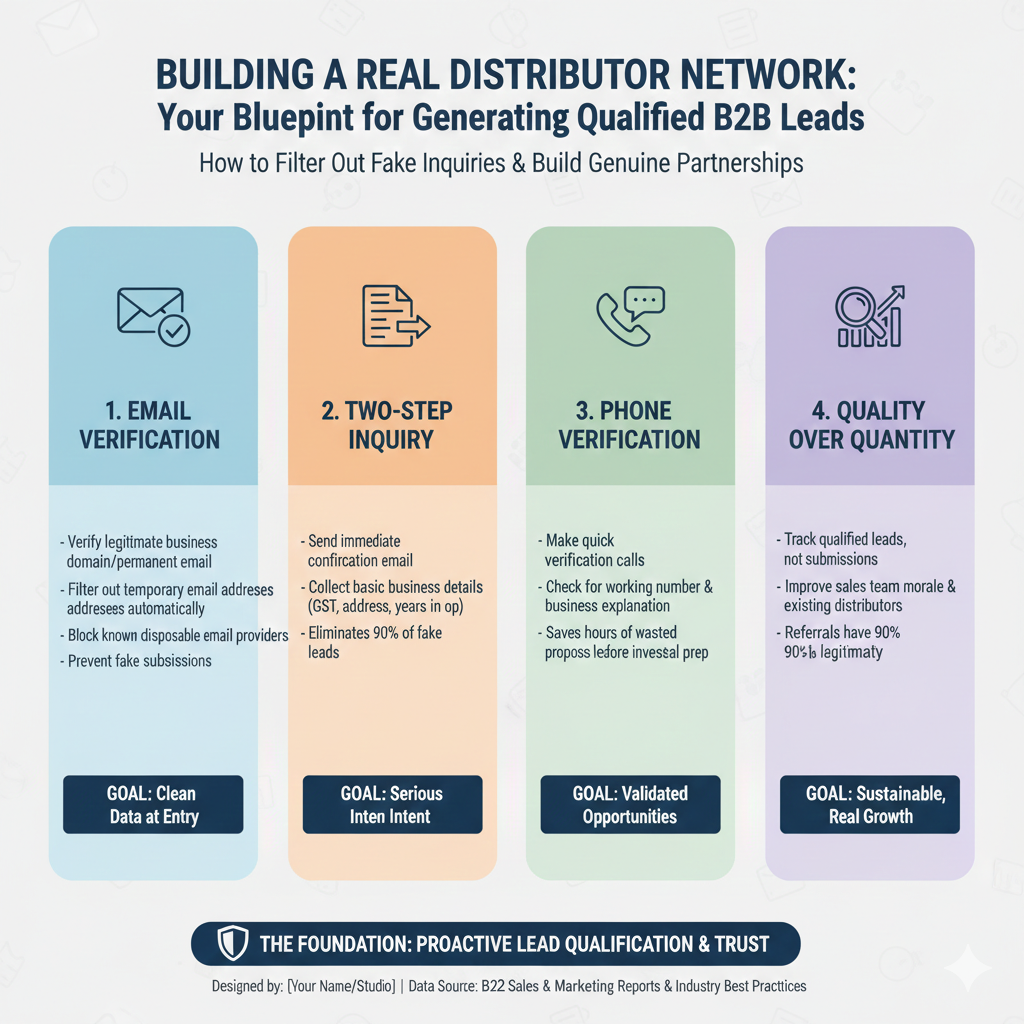
Email Verification at Entry: Before responding to any distributor inquiry, verify the email address is legitimate and belongs to an actual business domain or permanent personal email. Temporary email domains can be filtered automatically—there are hundreds of known temporary email providers that serious B2B businesses should block at form submission.
Two-Step Inquiry Process: When someone submits a distributor inquiry, send an immediate confirmation email requiring them to click a verification link and provide basic business details (GST number, business address, years in operation). This single step eliminates 90% of fake inquiries because temporary email users won’t complete verification.
Phone Verification: Real distributors have working phone numbers. Before preparing detailed pricing proposals, make a quick verification call. If the number is disconnected, wrong, or they can’t explain their business coherently, you’ve saved hours of wasted proposal preparation.
Quality Over Quantity: Stop celebrating “50 inquiries this month!” Celebrate “10 verified, serious distributor conversations this month.” Build metrics around qualified leads, not form submissions. Your sales team’s morale improves when they’re working real opportunities instead of chasing shadows.
Referral-Based Growth: Your best distributors know other potential distributors in their networks. Incentivize referrals. A salon owner who’s successfully distributing your nitrile gloves to 20 other salons in her city can refer friends who are also opening salons. These referral inquiries have 90%+ legitimacy compared to cold form submissions.
Case Study: The Glove Manufacturer Who Cleaned House
Arun runs a nitrile glove manufacturing facility in Tamil Nadu. His website’s “Become a Distributor” form was generating 60 inquiries monthly. His two-person sales team was drowning, following up on every inquiry, preparing pricing proposals, and sending catalogs.
Conversion rate: 1.6% (one actual distributor per month from 60 inquiries)
He implemented email verification:
- Added a filter blocking known temporary email domains at form submission
- Required phone verification before sending detailed pricing
- Implemented a “serious inquiries only” qualification step
Result: Inquiries dropped to 12 per month. His team panicked initially—”We lost 80% of our leads!”
But conversion rate? 25%. Three actual distributors per month from 12 verified inquiries.
Same sales team capacity, 3x the distributor acquisition. Plus, his email deliverability improved because he wasn’t sending to dead addresses anymore. His proposals to real distributors started landing in primary inbox instead of spam.
Annual impact:
- Before: 12 distributors acquired, ₹72 lakhs wasted on fake lead follow-up
- After: 36 distributors acquired, ₹15 lakhs spent on verified lead follow-up
- Net improvement: 3x distributor growth + ₹57 lakhs cost savings
The Mindset Shift
The hardest part isn’t implementing verification—it’s accepting that most of your “leads” aren’t real.
You want to believe that 50 inquiries means 50 potential distributors. It feels good to see those numbers. It feels like momentum, like business growth.
But feeling good about fake metrics doesn’t build actual distribution networks. It wastes time, money, and demoralizes your sales team when 90% of their efforts lead nowhere.
The manufacturers who succeed in building nationwide distribution networks don’t have the most inquiries. They have the highest-quality inquiries and the discipline to ignore the fake ones.
Taking Action
Audit your distributor inquiries from the last three months:
- How many emails bounced?
- How many never responded to follow-up?
- How many asked for pricing then disappeared?
- How many provided temporary email addresses?
- What percentage actually became distributors?
If your conversion from inquiry to distributor is below 5%, you have a lead quality problem, not a sales problem.
Fix lead quality first. Verify emails. Require business information. Make one verification phone call before investing hours in proposal preparation.
Your sales team will thank you. Your email deliverability will improve. Your competitor intelligence won’t leak through fake inquiry forms. And you’ll actually build the distributor network you’ve been trying to create, instead of just collecting fake form submissions.
Because in B2B, quality of leads matters infinitely more than quantity. One serious salon owner ready to distribute your products to her network is worth more than 100 temporary email addresses collecting your pricing sheets.
Stop celebrating fake metrics. Start building real distribution.
Your business—and your sales team’s sanity—depends on it.